
Best Window Treatments for Your Sliding Glass Door
If you have a porch, deck, or patio, you probably have a sliding glass door.
And if you have a sliding glass door, then you know that they can provide a lovely unobstructed view as well as let in lots of natural light.
But those same benefits can pose some unique challenges for maintaining your privacy and controlling just how much light (and heat) comes through.
Because of the way they slide horizontally, most traditional, vertically-raising window treatments are less than ideal.
Sliding doors work side-to-side – most window treatments raise bottom-to-top. Most people prefer their treatment movement to match the movement of the opening.
Most window treatments stop a few feet off of the ground, inline with the window sill - making it super easy to adjust the position.
Sliding doors extend to the floor - with a traditional window treatment, you’d have to bend all the way down to the floor to adjust the position.
There is no rule against a traditional shade for sliding glass doors, and if you like that look and functionality, go for it!
This post is for those looking for alternatives. One of the most common questions we field is from clients with a sliding glass door, wondering what their options are.
If that describes your situation, we’ve got you covered.
This post will explore 4 options for window treatments on a sliding glass door.
Option 1: Nothing
You may think “Well, that’s just cheating: nothing isn’t an option, it’s just… nothing!”
But for some people, nothing is just the option they prefer.
The benefits of leaving your sliding glass doors bare of treatment are that you have an unobstructed view outside, and a ton of natural light. This is coincidentally the most budget-friendly option as well!
This is a good option if you aren’t concerned about privacy outside that door and heat isn’t an issue.
If your sliding door backs up to woods, or you live on endless acres with no neighbors in sight, maintaining your view may be preferred.
Similarly, if that door is north facing, and the Alabama sun doesn’t pose much of an issue, there may not be a functional need to cover that opening.
Nothing is an option.
Option 2: Vertical Blinds
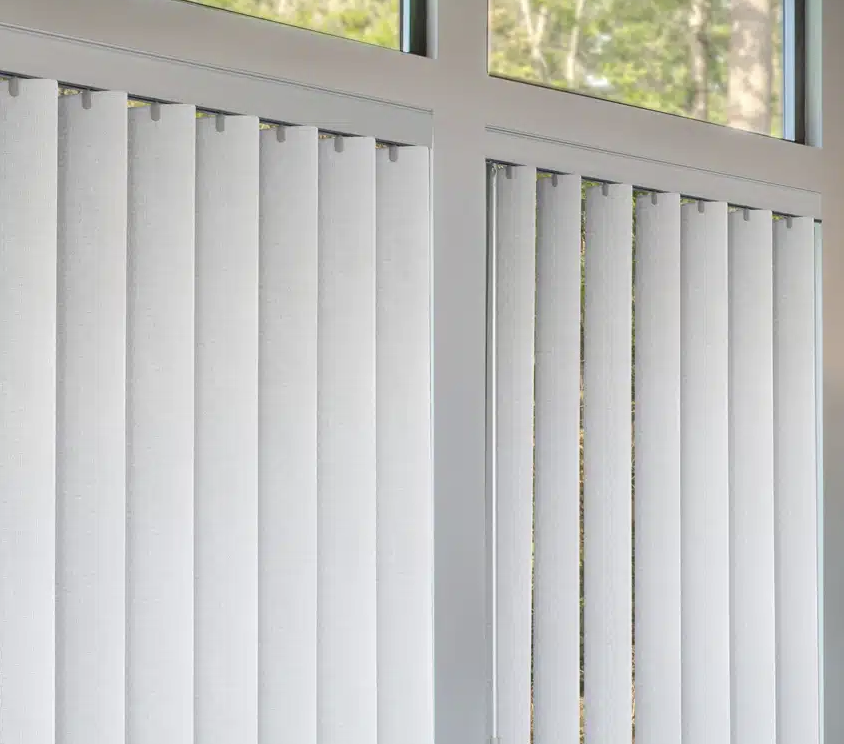
Nearly everyone is familiar with Window Blinds - those horizontal slats connected with strings that can tilt via a tilt want.
Window blinds have a cousin: Vertical Blinds.
Like the name suggests, this is a treatment made of vertical slats that can tilt open or closed, and can stack on one side so that they’re out of the way entirely.
Pros of vertical blinds:
These treatments are a great option for people who want an inexpensive way to create privacy and light control.
The tilting slats mean you have granular control of how much light you allow in, and can be closed for complete privacy at night.
Cons of vertical blinds:
This classic treatment hasn’t changed much throughout the years, and the customization options remain limited.
The slats on vertical blinds are more fragile than other options. They are prone to slip out of the track, and prone to crack.
If you opt for vertical blinds, it is highly recommended that you order 2-3 replacement slats as they will inevitably need replacement.
Cost for vertical blinds:
Just as window blinds are the most economical window treatment option, vertical blinds are the most economical sliding door option. If we take 72” by 84” as measurements for a typical sliding glass door, these treatments come in around $500 - $750.
Option 3: Vertical Honeycombs
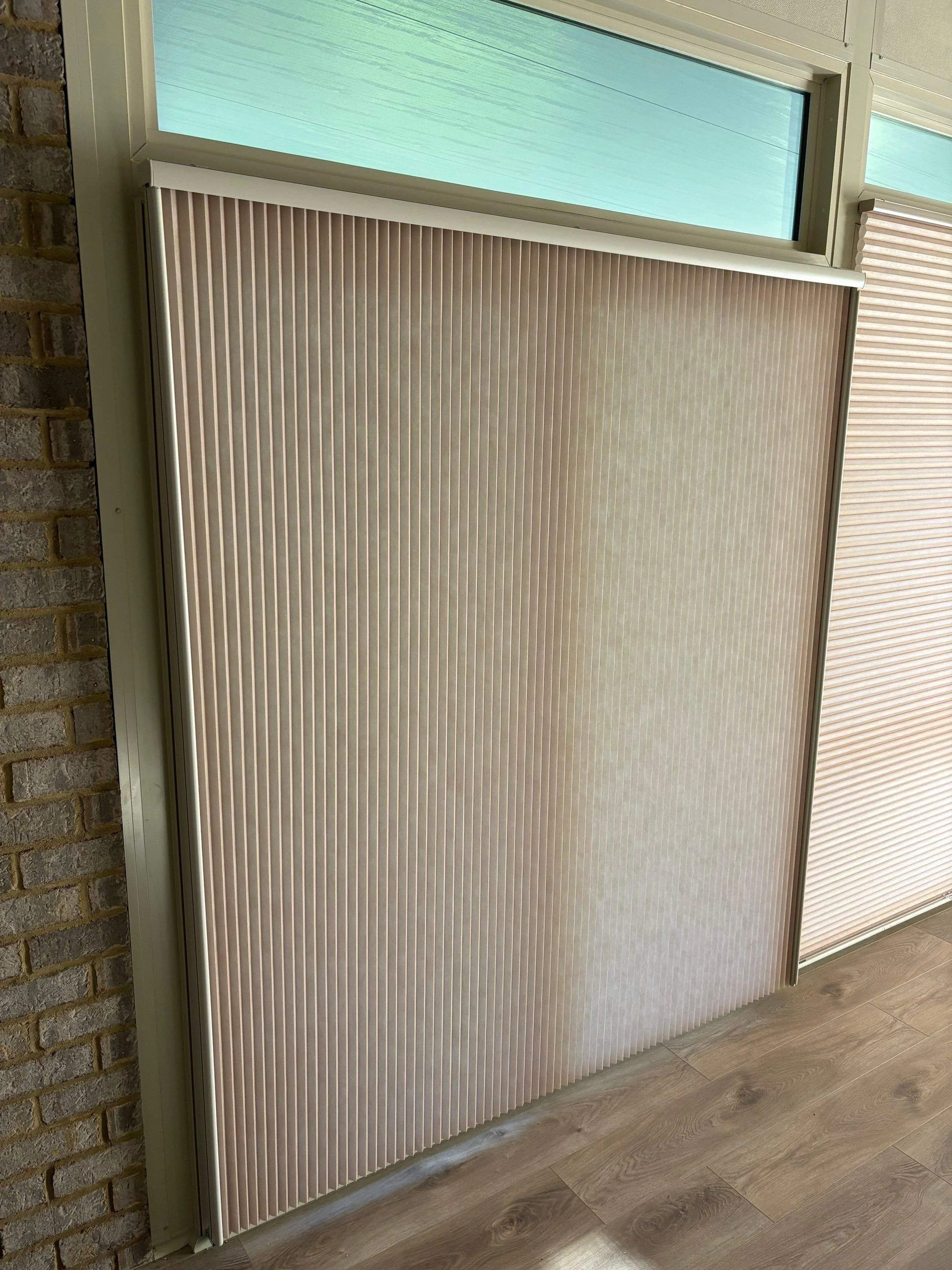
Honeycombs shades are an excellent choice for most window treatment applications.
Are you concerned about temperature? The cells that make up a Honeycomb shade are designed to better insulate your windows.
What about light? Honeycombs can filter the light beautifully - or block it out completely because of how tightly they can fit into a frame.
Now you can get the same benefits for a sliding glass door.
Vertical Honeycomb shades are what you get when you take a Honeycomb shade from your window and turn it sideways.
Pros of a vertical honeycomb shades:
They are excellent for insulation
They can come in either light filtering or room darkening fabric, for the right amount of light control for your needs
They have a modern sleek design.
Cons of vertical honeycomb shades:
Vertical honeycomb shades are a solid unit - when they’re closed, there’s no peeking through, and you’ll have to open them to open your door.
Cost for vertical honeycomb shades:
For an average 72” by 84” sliding glass door, a vertical honeycomb shade can range from $1200 - $1500.
Option 4: Smartdrape
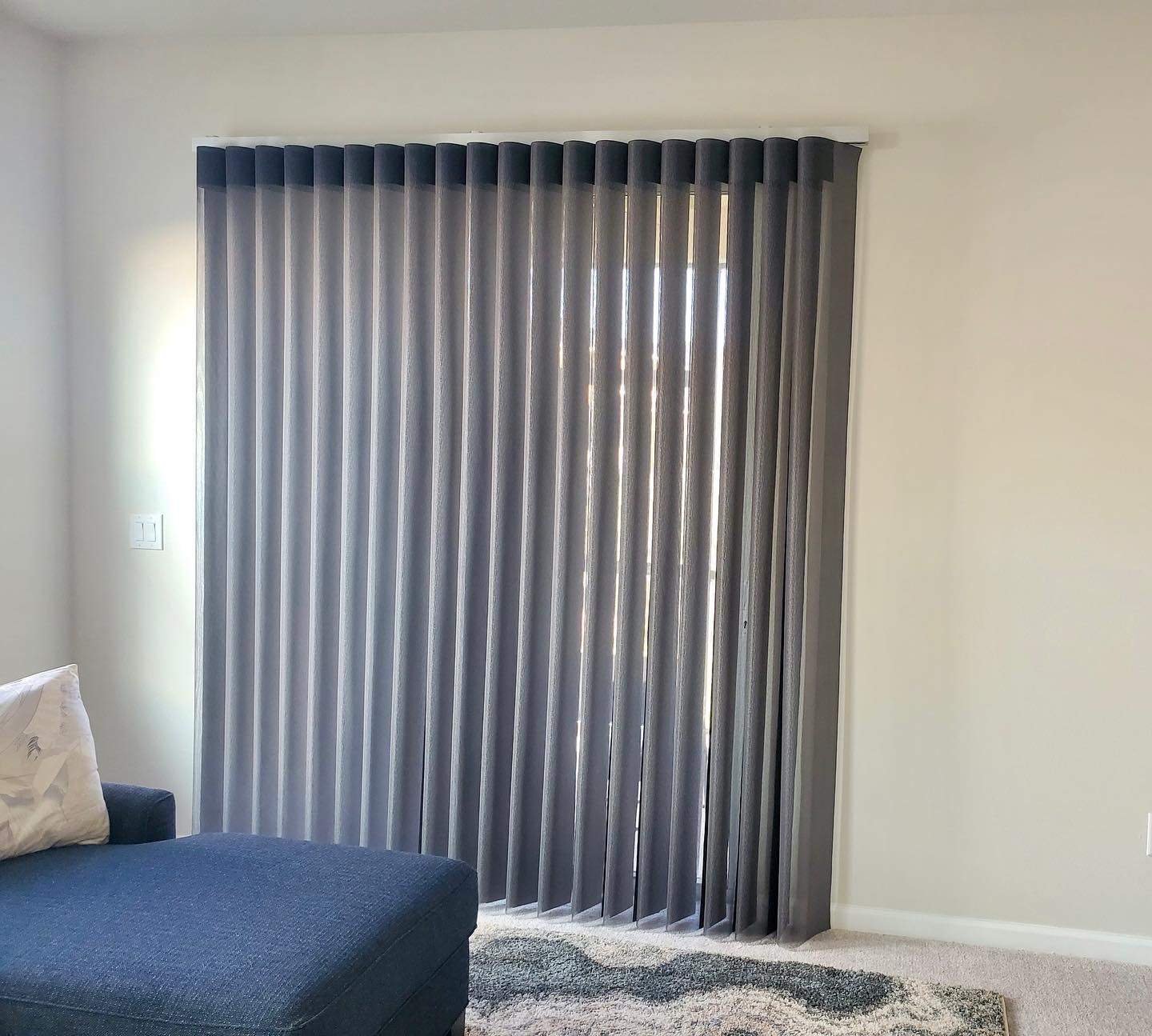
The last option we will cover here combines the elegance of drapery with all of the benefits of vertical blinds (and none of the downsides).
Smartdrape shades are composed of vanes of fabric that hang vertically, giving the appearance of drapery. The difference is that these vanes can tilt open or closed, letting light through or shutting it out.
They are also hung individually, much like the slats of a vertical blind, meaning you don’t have to open this treatment to let the dog out - Fido can run right through the fabric. The fabric can also stack to one side to fully open up your doorway.
Pros of a SmartDrape:
Can be motorized
The individual vanes allow for humans or four footed friends to walk through the treatment, without harming the treatment. No need to open the SmartDrape to get outside
Comes in light filtering and room darkening fabrics
If an individual vane is damaged, it can easily be replaced
Cons of a SmartDrape:
It is the most expensive of the options we’ve walked through here.
Fewer color options than vertical honeycomb
Cost of a SmartDrape:
For an average 72” by 84” sliding glass door, a SmartDrape can range from $1600 - $1900
Conclusion
There are a variety of treatments well-suited to your sliding glass doors. The “best” treatment for your home comes down to preference and budget.
Get in touch with our Blinds and Borders team today and find the right treatment for your sliding glass door.
256-883-1786
