
Bahama Shutters in Huntsville: Stylish Sun and Heat Control
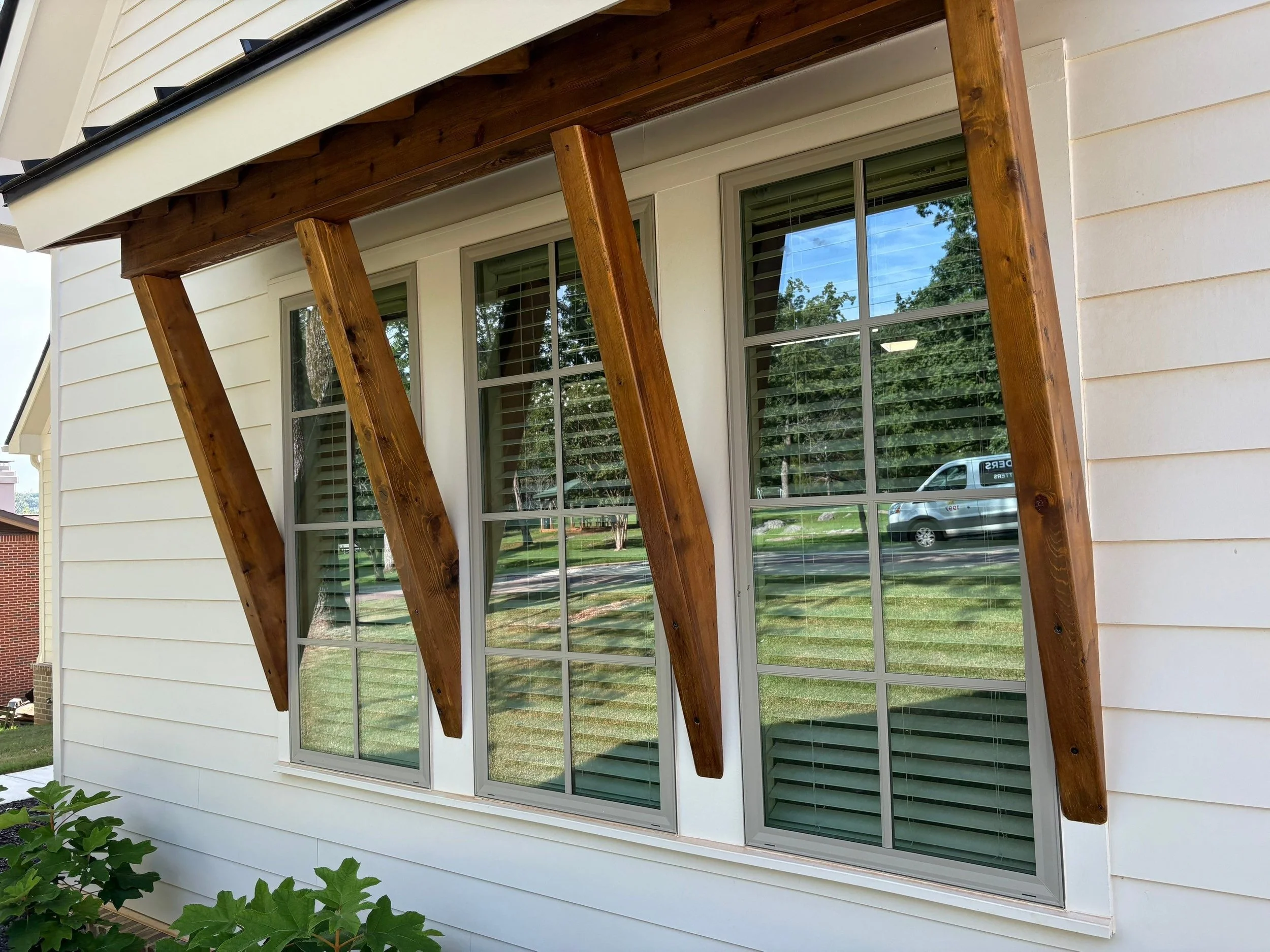
If you want to keep a room genuinely cooler, the most effective place to stop the sun is outside the glass, not inside it. Once sunlight passes through a window it has already become heat in your house, and every interior treatment from that point on is damage control. Bahama shutters, one of the most distinctive styles of exterior shutters we install, intercept the sun before it ever gets to the pane. That is the whole idea, and it is why they work.
They also happen to give a house a look you cannot get any other way. But the reason we put them on a west-facing wall is the temperature.
Stop the heat at the glass, not in the room
Think about the difference between standing in the sun and standing under a porch roof. Same air temperature, completely different experience. That is exterior shading, and it is the same principle at work on a window.
An interior shade absorbs solar energy after it has come through the glass and re-radiates a good portion of it into the room. It helps, and a good solar screen shade helps a lot. But it is working on heat that is already inside. An exterior shutter never lets the energy arrive. The sun hits the shutter, the shutter warms up, and the heat dissipates outdoors in the open air.
On a hot Alabama afternoon that is a meaningful difference on the surface temperature of the glass, on how hard the air conditioner runs, and on whether the room next to that window is usable at four o'clock.
What a Bahama shutter actually is
A Bahama shutter, also called a Bermuda shutter, hinges at the top, above the window, and props outward at an angle. It forms a louvered awning over the glass.
Three things follow from that shape:
Shade without darkness. The louvers block direct sun while letting daylight bounce in underneath. You are not trading a bright room for a cool one.
Airflow stays open. The shutter stands off the wall, so it is not trapping a pocket of hot air against the window the way a solid awning can.
The angle sets the coverage. A steeper prop gives more shade and less view; a shallower prop gives more light. The prop arm is adjustable, so you can tune it seasonally.
Because they mount above the window rather than beside it, Bahama shutters also work on windows where a conventional pair has no wall space, like a window tight to a corner or up against a downspout.
Why this fits Huntsville specifically
You will read a lot of Bahama shutter content written for the Gulf Coast that leads with storm protection. That framing does not really apply here. Huntsville is well inland, we are not in a heavy hurricane zone, and buying shutters for storm shuttering is not the reason a North Alabama homeowner should be looking at these.
What we do have is long, hot summers and a lot of houses with big unshaded west and south exposures. That is the actual local problem. Late-day sun on a west wall drives up the temperature in the room behind it, fades floors and furniture, and makes one part of the house consistently less comfortable than the rest.
Bahama shutters address that directly, and they do it from outside where the intervention is most effective. If your afternoon problem room faces west, this is a style worth pricing.
Where they suit a house and where they do not
They read coastal and Southern, with real character. On a cottage, a bungalow, a home with board-and-batten siding, or anything where you want the exterior to look less builder-standard, they land well. On a strictly formal brick colonial they can look out of place, and a raised panel or louvered shutter is the better call.
Some practical checks we run on site:
Clearance above the window. The hinge needs mounting room, so a window sitting right under a soffit or a roofline may not work.
Swing space in front. The shutter projects out from the wall. On a narrow walkway or beside a driveway that clearance matters.
What the view is worth. A Bahama shutter permanently changes the sightline out of that window. In a room where the view is the point, we would probably steer you to interior solar screen shades instead, which cut heat and glare while preserving the view.
We would rather tell you a style is wrong for your house than sell it to you and have you look at it every day.
Where they fit in a whole-house sun plan
Bahama shutters are rarely the only answer. On most homes we end up with a layered approach: exterior shading where the sun load is worst, interior solar shades on the windows that need view retention, and patio shades on the outdoor space if there is one that goes unused in summer.
The point of leading with exterior shading is efficiency. Every bit of solar energy you stop outside is energy your interior treatments and your air conditioner never have to deal with. Start at the outside, then work in.
Frequently asked questions
Do Bahama shutters actually reduce heat? Yes, and they do it more effectively than an interior treatment on the same window, because they block the sun before it passes through the glass. Interior shades work on heat that has already entered the room.
Are Bahama shutters only for coastal or hurricane areas? No. They are common on the coast, but their day-to-day benefit is sun and heat control, which matters just as much on a hot inland exposure like Huntsville. Storm protection is not the reason to buy them here.
Do Bahama shutters make a room dark? Less than people expect. The louvers block direct sun while letting reflected daylight in below the shutter, so the room stays lit but stops feeling like it is baking.
Can Bahama shutters be adjusted? The prop arm sets the angle, so you can open them wider in cooler months for more light and lower them for more shade in summer.
What windows do not work for Bahama shutters? Windows with no mounting clearance above them, windows on a tight walkway where the projection would be in the way, and rooms where the view matters more than the heat. We check all three before recommending them.
Come at the heat from the outside
If there is a room in your house that nobody uses in the afternoon, the fix probably starts outside the window. We will come look at the exposure, tell you honestly whether Bahama shutters are the right tool for it, and price the options either way. Call (256) 883-1786 for a quote, or run the numbers yourself with our pricing tool.
