
Types of Exterior Shutters: A Huntsville Homeowner's Guide
Exterior shutters come in five main styles: raised panel, louvered, board-and-batten, Bahama, and combination. They all frame a window, but they do not all say the same thing about a house, and a few of them still do real work. Picking the wrong style is the most common reason exterior shutters end up looking bolted on instead of built in.
Before we get into the styles, one clarification that saves confusion on almost every call. Exterior shutters mount on the outside wall, flanking the window. Plantation shutters mount inside, on the window itself. Different product, different purpose. This guide is the outside.
Raised panel: the traditional default
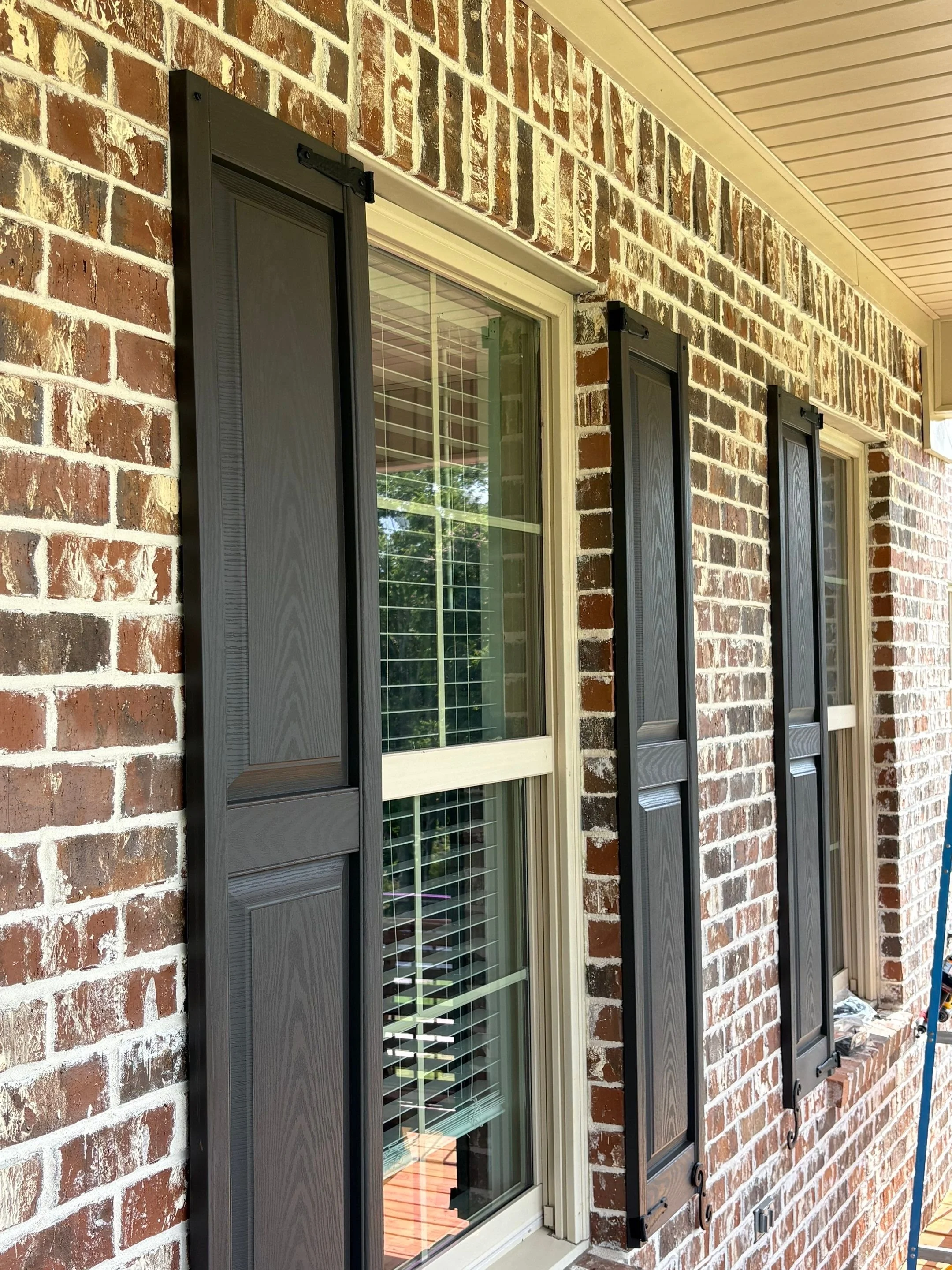
A raised panel shutter is a solid panel with a raised center field, usually split into two or three sections. It reads formal and traditional, and it is the style most people picture when they think "shutters."
It pairs naturally with brick, colonial and Georgian architecture, and the more traditional builder homes that fill a lot of Huntsville neighborhoods. Because the panel is solid, it also reads heavier and more substantial from the street than a louvered shutter of the same size, which is useful on a facade that feels a bit flat.
If your house has symmetrical double-hung windows and any amount of brick, raised panel is usually the safe answer.
Louvered: the classic Southern look
Louvered shutters use angled horizontal slats, the same idea as an interior plantation shutter but built for weather. Historically the louvers let air move through while the shutter stayed closed, which mattered a great deal in the South before air conditioning.
Visually they are lighter and more textured than a raised panel. The slats catch shadow through the day, so the shutter changes as the light moves rather than sitting there as a flat block of color. On a white or light-colored house, that texture is what keeps the shutters from disappearing.
Louvered suits colonial, cottage and traditional Southern homes. It is a slightly less formal look than raised panel while still reading classic.
Board-and-batten: farmhouse and craftsman
Board-and-batten is vertical boards held together by horizontal crosspieces, called battens. Two battens is the common setup; a Z-brace adds a diagonal.
This is the style that has carried the farmhouse trend, and it fits the way a lot of North Alabama homes actually look: siding, mixed materials, a covered porch, a shake or board gable. On a craftsman or a modern farmhouse, board-and-batten looks intentional in a way raised panel does not.
It is also the most forgiving style on a house with irregular window sizes, because the vertical boards do not need to resolve into a symmetrical panel layout.
Bahama: the style that does a real job
Bahama shutters (sometimes called Bermuda shutters) mount on a hinge above the window and prop outward at an angle, forming a louvered awning over the glass.
They are the one exterior style that changes how a room feels inside, because they intercept sunlight before it reaches the window. In Alabama that is a genuine benefit rather than a decorative one. They also give a house an unmistakable coastal-South character, so they are a style choice as much as a functional one.
They suit cottages, coastal-influenced homes, and any facade where you want the exterior to look a little less standard. We have written a full piece on how Bahama shutters handle sun and heat if that is the part you care about.
Combination: panel below, louver above
A combination shutter puts a solid panel on the bottom half and louvers on the top, sometimes split by a horizontal rail.
It is a nice answer for tall windows, where a single raised panel starts to look like a slab and a full louver starts to look busy. The break in the middle gives the eye something to land on and matches the proportions of a tall double-hung. This is a less common pick, which is part of the appeal if you do not want your house to look like the three others on the street.
Functional or decorative changes what you can pick
Every style above can be built to actually close over the window, or built fixed as a decorative frame. Most homeowners today choose decorative, and that is completely fine.
What is not fine is decorative shutters that could never plausibly close. Each shutter should be sized to about half the window width so the pair would cover the opening, and mounted tight to the casing rather than floating a few inches out on the wall. Undersized shutters stuck flat to the siding are the single most common reason exterior shutters look cheap, and it has nothing to do with the style you chose.
If you go fully operable, that narrows things: you need functional hinges, adequate wall clearance for the shutter to swing, and a style that suits an operable build. We will tell you straight whether your windows can carry it.
How to narrow it down for your house
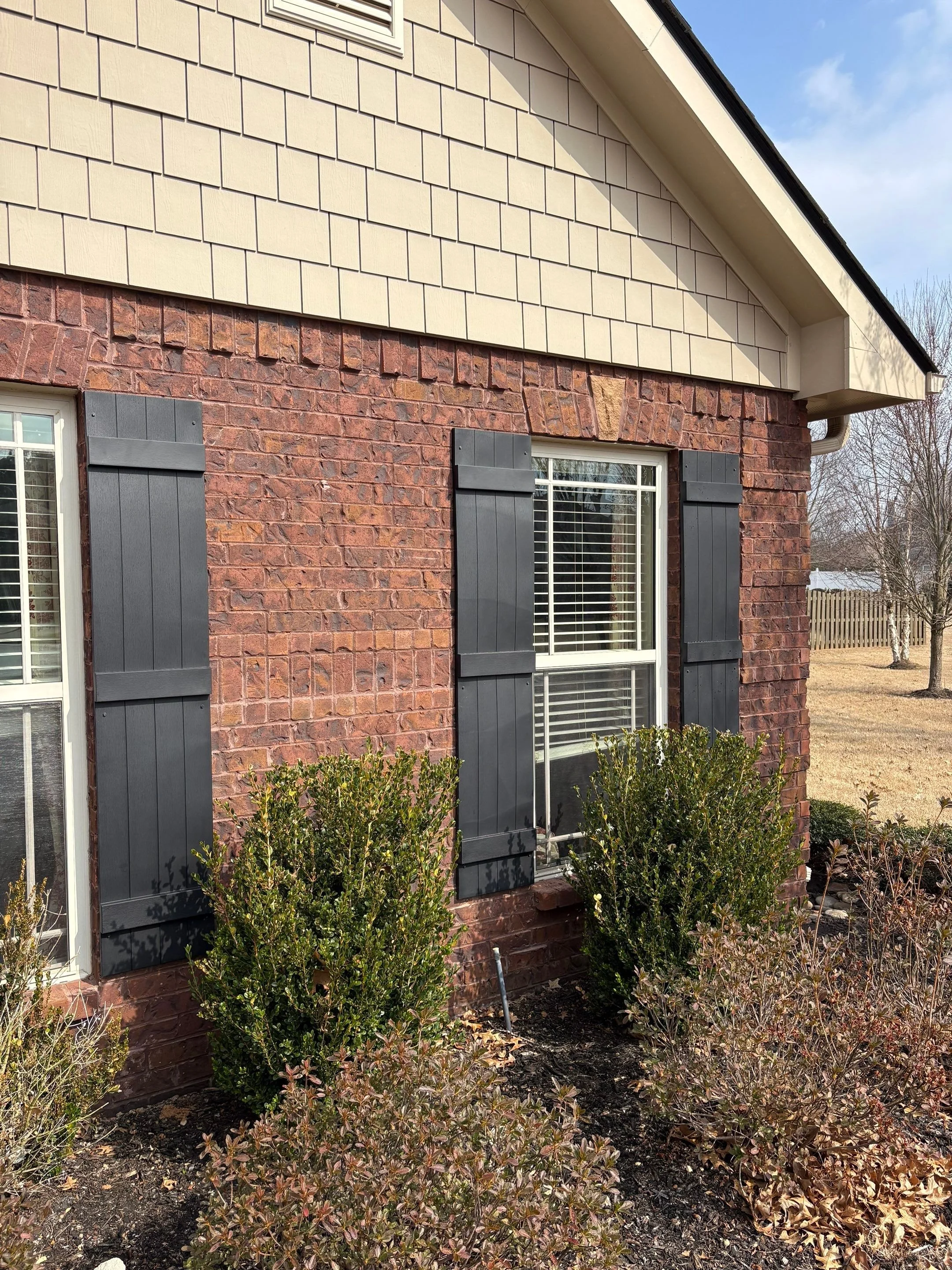
Start with the architecture, not the catalog. Brick and colonial leans raised panel or louvered. Siding, farmhouse and craftsman leans board-and-batten. Coastal or sun-heavy exposure makes Bahama worth a look. Tall windows open the door to combination.
Then check proportion and color. The shutter has to be sized to the window, and the color has to contrast enough with the wall that it frames the glass instead of blending in. A well-chosen style in the wrong size or the wrong color still looks wrong.
When we come out, we hold samples against your actual brick or siding in daylight, because colors behave very differently on a screen than they do on a west-facing wall at four in the afternoon.
Frequently asked questions
What are the main types of exterior shutters? Raised panel, louvered, board-and-batten, Bahama, and combination. Raised panel and louvered read traditional, board-and-batten reads farmhouse, Bahama doubles as sun control, and combination suits tall windows.
What is the difference between exterior shutters and plantation shutters? Exterior shutters mount on the outside wall to frame the window. Plantation shutters mount inside on the window itself and control light and privacy from within the room. They are separate products.
Which exterior shutter style is most popular in Huntsville? Raised panel is the most common, because so much of the local housing stock is brick and traditional. Board-and-batten has grown quickly with the farmhouse look on newer siding-clad homes.
Do exterior shutters have to be functional? No. Most are decorative today. They should still be sized and mounted so they look like they could close, or the decorative look falls apart.
Can you add shutters to any window? Most windows, yes, but not all. Windows tight to a corner, an adjoining window, or a downspout may not have the wall space for a properly sized pair. That is one of the things we check on site before recommending anything.
Pick the style, we will handle the rest
The style is the fun part. Sizing, material, hardware and a clean install are what make it hold up. If you want to see how a couple of these would look on your house, call (256) 883-1786 for a quote and we will bring samples out to you. You can also get a starting number from our pricing tool.
