
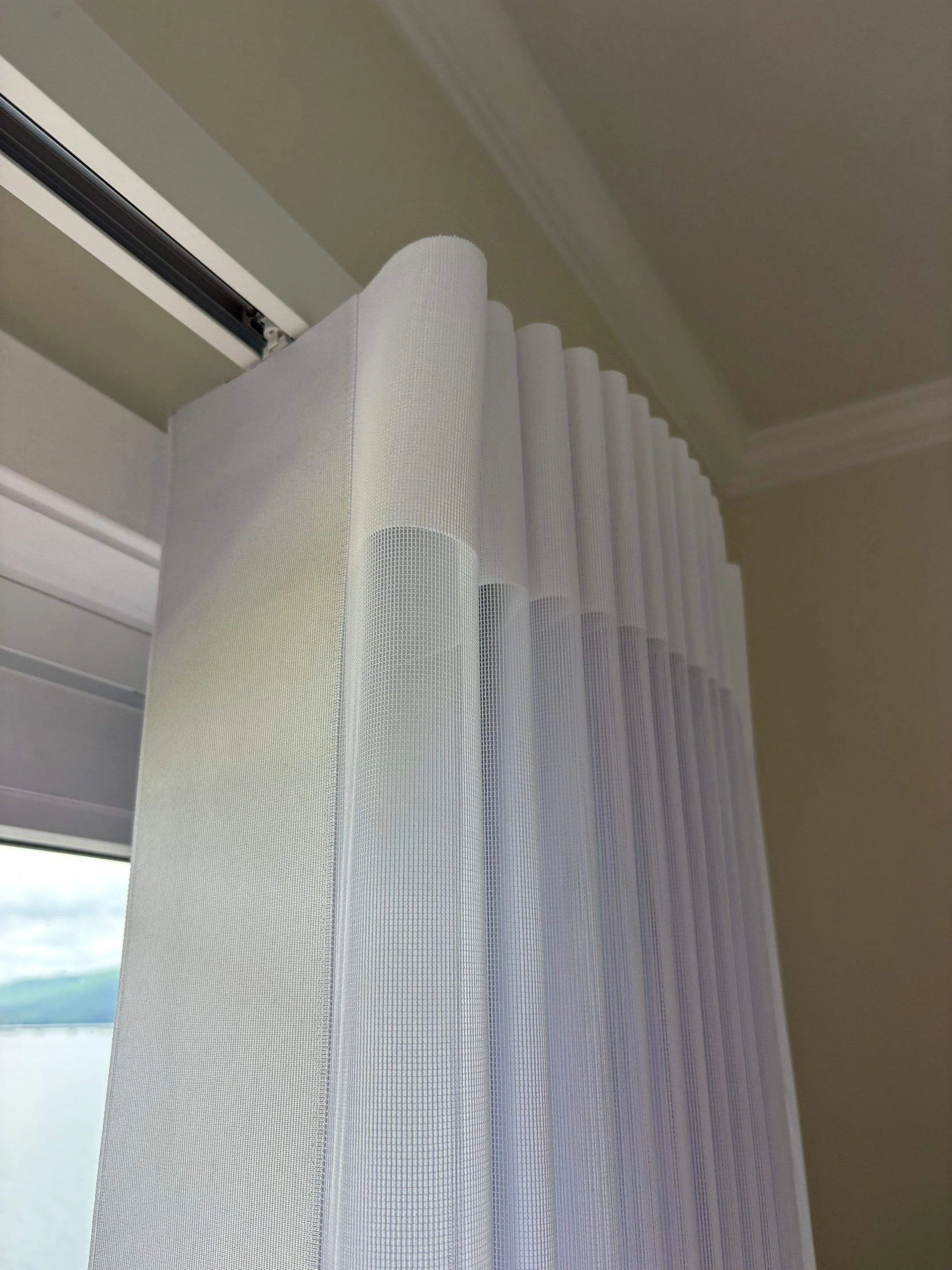
If you have to pick one, a well-fitted cellular shade will usually hold more heat at the window than drapery. It sits closer to the glass, traps air in its cells, and leaves smaller gaps for cold air to escape around. But a good lined curtain, hung the right way, is not far behind, and on the coldest windows in the house the real answer is to use both. Here is how each one works, where each one lets you down, and how to decide for your rooms. If you are leaning toward fabric, our custom drapery page shows what a lined panel looks like finished.
How a drapery keeps heat in
A drapery is a heavy panel with a lining (often a foam-backed or multi-layer fabric) that slows heat moving from the warm room to the cold glass. The weight matters, and so does the lining, but the thing most people miss is the hang.
Heat loss at a curtain is mostly about air movement. Warm room air drifts toward the window, cools against the glass, gets heavier, and drops. If the curtain stops a few inches above the floor or sits loose around the sides, that cold air spills out underneath and pulls more warm air in behind it. You get a slow loop of cold air rolling across the floor all evening.
So a drapery does its best work when:
The rod is mounted higher and wider than the window frame, so the panels overlap the wall on each side.
The fabric reaches the floor or just brushes it.
The panels meet in the middle with a little overlap instead of a gap.
It is closed at dusk, before the room has already cooled.
Get those right and a lined curtain makes a real difference. Get them wrong and it is mostly decoration.
How a cellular shade keeps heat in
Cellular shades, also called honeycomb shades, are built differently. The fabric folds into hollow cells that run the width of the window. When the shade is down, those cells hold a layer of still air right against the glass, and still air is a good insulator. That is the whole trick.
Because the shade mounts inside or just over the window frame, the gaps around it are small, especially with an inside mount. Less gap means less of that cold-air loop. A double cell shade traps two layers of air instead of one, and room darkening fabrics slow heat a bit more than light filtering ones.
We went deeper on the cell structure, single versus double cell, and fit in Do Cellular Shades Really Save Energy in Winter? if you want the detail. The short version: they are built for this job.
Drapery vs. Cellular shades
When evaluating window treatments for thermal efficiency, choosing between drapery and cellular shades depends on how you want the window covering to interact with the room's space and light. Drapery hang on a rod in front of the window and wall, offering a soft, decorative look that adds color and texture while suiting big picture windows, sliding doors, and rooms that need softness. They insulate by using heavy fabric and lining to slow heat transfer, but their biggest weakness is that gaps at the floor, sides, and top let cold air loop around the barrier. Furthermore, their light control is binary: they are either open or closed, with not much in between.
In contrast, cellular shades fit snugly in or on the window frame, close to the glass, creating a clean, minimal appearance that nearly disappears when raised. They excel in bedrooms, offices, and any window you want to keep clear and tidy. They insulate by using trapped air in their honeycomb cells to slow heat transfer, and while their biggest weakness involves small side gaps on outside mounts, they offer superior versatility. Unlike curtains, top-down, bottom-up options let light in while keeping privacy, giving you fine control over both illumination and insulation.
Neither one is wrong. They solve the same problem from different distances.
Where each one falls short
Curtains struggle when the hang is off, which is most of the time with off-the-shelf panels. A standard rod mounted right at the trim, with panels that stop at the windowsill, will not keep much heat in no matter what the package says. They also stack back and take up wall space, which matters on a window next to a corner or a bookcase.
Cellular shades struggle on very wide openings like sliding glass doors, where a single horizontal shade gets heavy and awkward. (A vertical cellular shade or a SmartDrape is usually the better fit there, and we covered that in our sliding glass door guide.) They can also look a little plain in a formal living room if that is the only thing on the window.
Why the warmest windows have both
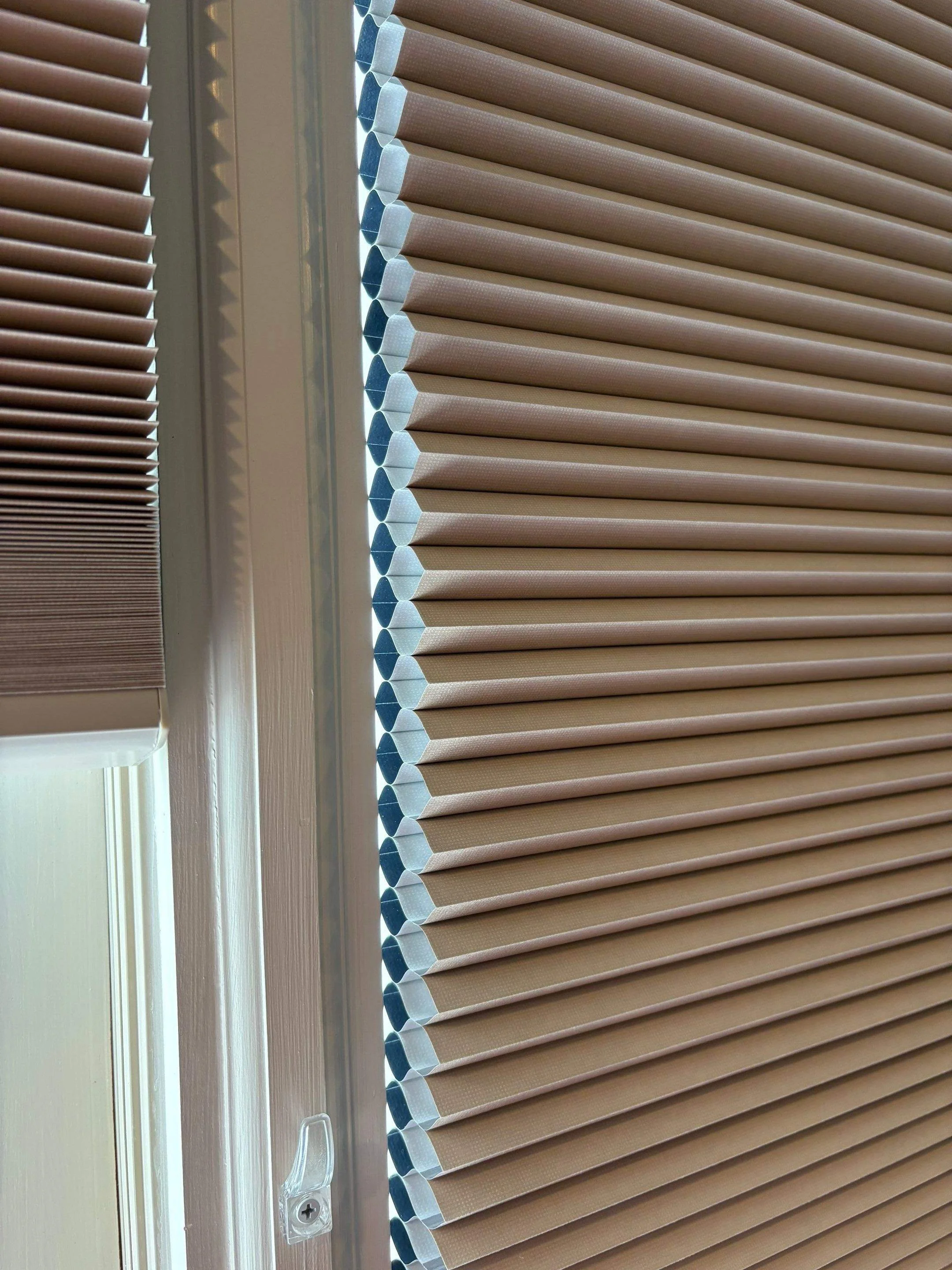
On a north-facing wall, a big picture window, or the room nobody wants to sit in after dark, layering wins. A cellular shade down against the glass, with lined drapery closed over it, gives you two barriers and a pocket of still air between them. That pocket is the part that does the work.
Layering also fixes each product's weak spot. The shade handles the close-to-the-glass insulation and the daytime light control. The curtain covers the gaps around the shade and adds the softness a cellular shade alone does not have. During the day you can raise the shade and pull the drapery open to let the winter sun warm the room, then close both at dusk.
If you already have curtains you like, adding a cellular shade behind them is often the cheapest upgrade with the biggest payoff. If you already have shades, a set of lined panels on a properly placed rod does the same thing from the other side.
So which should you choose?
A quick way to sort it out:
You want one product and the most heat held per window: cellular shades, inside mounted, double cell if the room runs cold.
The window is wide, a slider, or you want color and softness: thermal or lined drapery, hung high, wide, and to the floor.
The room is the coldest in the house: both. Shade against the glass, drapery over it.
You care about daytime light as much as night-time warmth: cellular shades with a top-down bottom-up lift.
Trend-wise, a lot of Huntsville homeowners are coming back around to drapery for the look alone. We wrote about that in trending custom curtains. The nice part is that the same lined panel that looks good also earns its keep in January.
When to call us instead of guessing
This is the point where a tape measure and a store-bought panel stop being enough. The insulation you get from either product depends mostly on fit, and fit is measured, not eyeballed. If you have a room that never warms up, we can come out, look at which way the windows face, and tell you plainly whether a shade, drapery, or both is worth it. Call us at (256) 883-1786 and we can often give you a ballpark on the phone.
Frequently asked questions
Do drapery really work? Yes, when they are hung correctly. A lined curtain that reaches the floor, overlaps the wall on each side, and is closed before the room cools will noticeably cut heat loss. Short or loose panels do much less.
Are cellular shades better than drapery? For heat held per window, a well-fitted cellular shade usually comes out ahead because it sits close to the glass and traps air in its cells. Curtains are better on wide openings and when you want color and softness.
Can I use drapery and cellular shades together? Yes, and on cold rooms it is the best setup. The shade insulates at the glass, the curtain covers the gaps, and the air between them adds another layer.
Do blackout curtains keep heat in? Blackout curtains are heavy and often lined, so they help, but blocking light and blocking heat are different jobs. What matters most for warmth is the lining and how well the panel seals against the wall and floor.
Should drapery touch the floor? Ideally yes, or just brush it. A gap at the bottom lets cold air slide out underneath, which undoes a lot of the benefit.
Warm up the cold rooms first
Most homes do not need new treatments on every window. They need the right fix on the two or three windows that make a room uncomfortable. Start there. Call (256) 883-1786 for a quote, or price your window treatments online if you would like a number before we talk. Our own crew handles the install, and every job comes with a lifetime installation guarantee and three years of service calls.
